
DeAutoLED Premium LED Headlight Kit Review
A premium early LED kit that delivered exceptional reflector output, a controlled halogen-like beam pattern, clean 5700K color, and vehicle-focused electronics in the original BulbFacts test.
- Reflector low beam
- 7,080 luxper bulb · historical v1.0 test
- High-beam output
- 5,050 luxper bulb · historical v1.0 test
- Beam pattern
- 4.5 / 5separate reflector rating
- Color temperature
- 5,700 Kmeasured
Our verdict
The DeAutoLED Premium stood out in its original comparison by placing substantially more light into the useful reflector hotspot while maintaining a halogen-like pattern. Its clean 5700K color, low 23-watt-per-bulb draw, tested dashboard-error behavior, lifetime warranty, and strong support made the roughly $135 price easier to justify in 2018. It is now discontinued, the measurements use the historical version-1.0 bench, and projector, lumen, radio-interference, and long-term durability results were not recorded.
What we liked
- Reflector low beam measured 7,080 lux per bulb, 340% above the stock-halogen result recorded in the original test.
- The separate 4.5 / 5 reflector beam-pattern rating and 55-lux glare result documented controlled light placement for an early high-output LED.
- Clean 5700K color, low electrical draw, vehicle-focused electronics, and a lifetime warranty supported its premium positioning.
What to consider
- The reviewed Premium kit is discontinued and must not be confused with the newer deNX Gen TR 2.0 entry in the current chart.
- No projector result, integrating-sphere lumen measurement, completed lifespan result, or radio-frequency-interference result was preserved.
- The external driver, rear fan, H7 adapter needs, emitter orientation, headlight aim, housing geometry, and exact-vehicle electronics still require checks.
Build quality
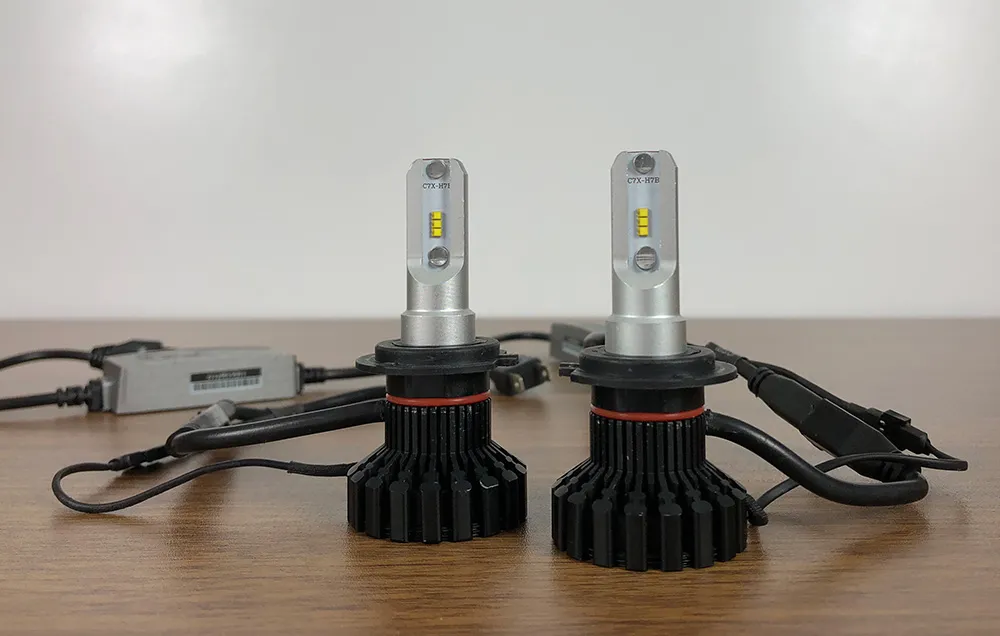
The Premium kit was positioned above generic Amazon LEDs and aimed especially at Volkswagen Group vehicles. The original review compared it with inexpensive LED kits, DeAutoLED’s H7RC HID kit, and the stock halogen bulbs to see whether the higher price bought more than marketing claims.
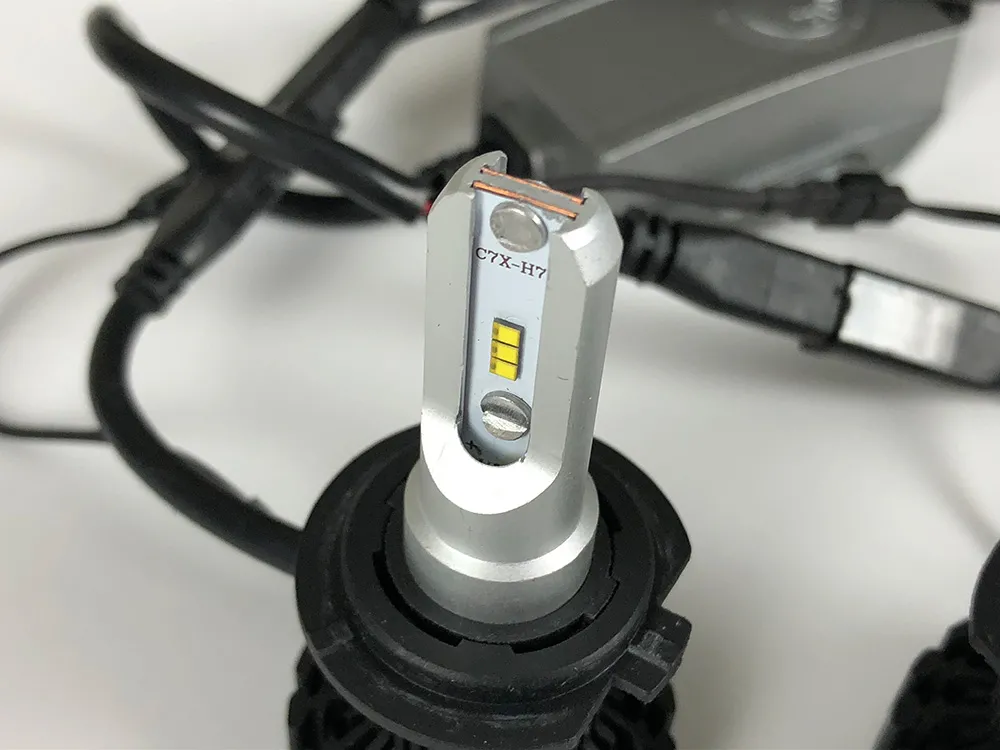
Each bulb uses six flat-mounted emitters placed to mimic a halogen filament, a 32 mm fan-cooled heat sink, and a separate external driver. The collar rotates in 90-degree increments, giving the installer some control over emitter orientation inside the housing.
The package is more involved than a halogen bulb but simpler than the HID kit used in the original comparison. Its construction and support felt premium for the period, but the reflector evidence below—not appearance, packaging, or brand positioning—is what supports the review conclusion.
Reflector headlight performance
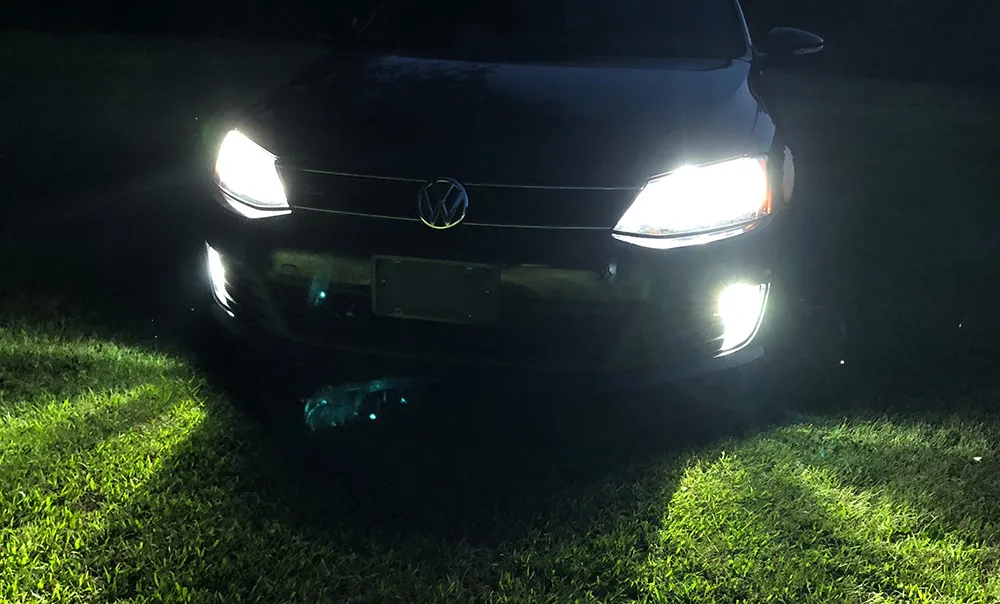
The DeAutoLED Premium produced exceptionally strong low-beam output while retaining a pattern that closely resembled the halogen filament geometry used by the reference reflector.
Historical-test context: These values come from the version-1.0 BulbFacts bench at 12 feet and its earlier glare geometry. They are historical evidence, not directly comparable with current 25-foot chart values, and they do not guarantee the same result in a selected vehicle.
The archived Premium-kit review separately recorded a 4.5 / 5 beam-pattern rating, but no numerical performance score. The 5.7 score in today’s chart belongs to the different DeAutoLED deNX Gen TR 2.0 and is not reused here.
- Low-beam hotspot
- 7,080 luxper bulb · historical v1.0 test
- High-beam output
- 5,050 luxper bulb · historical v1.0 test
- Glare measurement
- 55 luxat 8 in · historical test
- Beam pattern
- 4.5 / 5separate pattern rating
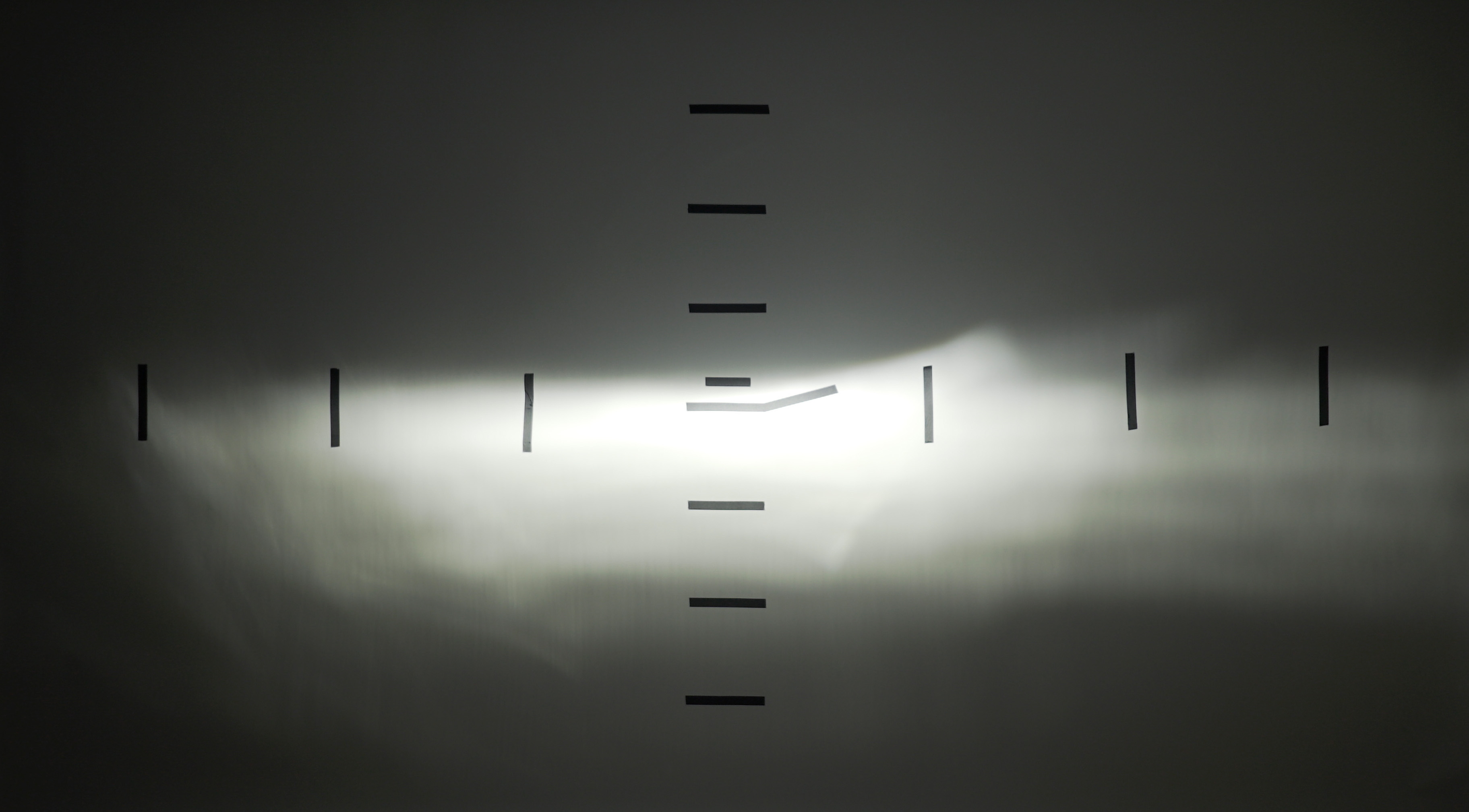
Low beam measured 7,080 lux per bulb at 12 feet. The original article described that as 340% more light, or almost 4.5 times the stock-halogen result recorded on that bench. It also reported 168% more low-beam light than the then-leading Lightening Dark kit and 325% more than the Cougar Motor kit in the same early comparison.
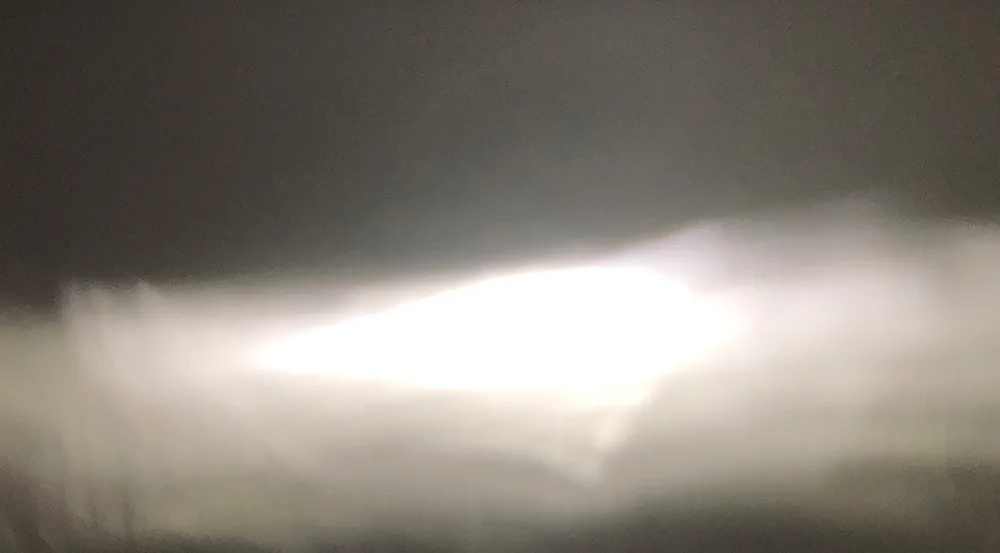
The separate 4.5 / 5 beam-pattern rating describes beam shape, not an overall score. The 55-lux glare result at 8 inches and the photograph support the review’s finding that the flat emitter placement kept the pattern close to halogen while concentrating much more light in the useful hotspot.
High beam measured 5,050 lux per bulb. The numeric result is preserved even though a matching high-beam photograph was not. Housing optics, seating, emitter orientation, lens condition, and aim can all change output, distribution, and glare in an exact vehicle.
Projector headlight performance
The archived DeAutoLED Premium review did not preserve a projector measurement, rating, or matching photograph.
No Premium-kit projector hotspot, improvement, glare, beam-pattern rating, or performance score was preserved. Reflector results and newer DeAutoLED product data cannot be substituted for that missing evidence.
- Low-beam hotspot
- Not recordedhistorical Premium-kit review
- High-beam output
- Not recordedhistorical Premium-kit review
- Beam pattern
- Not ratedno numerical projector record
An unavailable projector result is not a failed test. The original article focused on a reflector housing, so this page makes no projector recommendation and does not generalize the strong reflector result to optics that were not documented.
The current chart includes the newer DeAutoLED deNX Gen TR 2.0, but that entry was tested with a newer process and is a different product. Its scores and photographs remain on the chart instead of being used to fill gaps in this Premium-kit review.
Output, color, and recorded behavior
The surviving Premium-kit record provides reflector hotspot measurements and color temperature, but not integrating-sphere lumens or warm-up stability measurements.
DeAutoLED Premium Kelvin
DeAutoLED Premium hotspot
The kit claimed 5500K and measured 5,700K, close to the claim and visibly whiter than the roughly 3300K stock halogen used in the original comparison. The review described a clean white color with a slight cool tint, not the more strongly blue appearance it saw from many 6000K–6500K Amazon kits.
Reflector low and high beam are hotspot measurements in lux, not total lumens. The archive does not preserve an integrating-sphere lumen result, a cold-start-to-running output change, or a two-minute-to-running stability result, so those fields remain unavailable.
For brand context only, the current chart lists the newer DeAutoLED deNX Gen TR 2.0 at a 5.7 reflector performance score, 1,283 low lux, 1,952 high lux, 5,750K, 4,640 measured lumens, and 45.9 watts. Those newer-process measurements belong to a different product and are not mixed into this Premium-kit result.
Installation and cooling
The 32 mm heat sink, external driver, active fan, H7 adapter possibility, electrical draw, and vehicle-electronics behavior are the practical details to verify before maintaining an existing installation or considering old stock.
Per-bulb draw
Recorded temp
Fan noise
Physical size and fit
The archived facts record a 32 mm heat-sink size, although the exact dimensional basis and full base-to-rear length were not preserved. The collar rotates in 90-degree increments. Original sizes were H7, H4, H8, H11, 9005, and 9006, with the product especially aimed at Volkswagen, Audi, Porsche, and other VW Group applications.
Installation was described as easier than HID because there were fewer components, though still more involved than halogen because of the external driver and cooling hardware. An H7 application may require a vehicle-specific adapter. A matching bulb size alone does not confirm fitment: verify seating, orientation, rear clearance, driver placement, dust-cover space, aim, local legality, and electronics in the actual vehicle.
Power draw and cooling
Electrical draw measured 23.0 watts per bulb. The 46.0-watt pair total is derived from that per-bulb result rather than independently measured as a complete kit.
Running temperature was recorded at 105°F / 41°C. The archive does not preserve the exact timing basis, so it is not relabeled as a 30-minute result. The rear fan and 32 mm heat sink manage that heat, but this short bench measurement is not a durability test.
Noise and electronics
Fan noise measured 62 dB on the bench. No in-cabin sound measurement was recorded, so that value does not predict how loud an installation will sound from the driver’s seat.
The original tested setup produced no dashboard bulb-out errors, useful evidence for the vehicle-sensitive positioning of this kit but not a guarantee for every Volkswagen Group or other vehicle. The recorded DRL/high-beam dimming result is No. Radio-frequency interference was not recorded.
Warranty and long-term testing
Coverage
The Premium kit was listed with a lifetime warranty, and the original review described positive replacement support from DeAutoLED. That is manufacturer or seller coverage, not evidence of measured service life; current terms should not be assumed for a discontinued product.
Long-term lifespan testing remains N/A. The low running temperature, warranty, and service experience do not replace a completed runtime result.
Should you buy it?
The DeAutoLED Premium remains a strong historical reflector result. Its 7,080-lux low beam, 4.5 / 5 pattern rating, low recorded glare, clean color, modest electrical draw, and lifetime warranty explain why the original review found it worth more than generic kits.
It is not a current buying recommendation. The Premium kit is discontinued, the version-1.0 numbers are not directly comparable with today’s chart, and projector performance, total lumens, long-term durability, RFI behavior, and exact-vehicle fitment remain unconfirmed.
Existing owners can use these results to understand the tested product, but should still verify seating, orientation, aim, cooling clearance, wiring, and vehicle electronics. New buyers should compare current products, including the newer DeAutoLED entry, without treating it as the same kit.
Compare current chart results and recommendations before choosing a replacement.
Full measurements and specifications
Open this reference for every recorded measurement, specification, unavailable field, and test-version detail. The main reflector findings remain visible above.
Show all recorded measurements and specificationsFive groups · version 1.0 bench record
Measured output
- Reflector performance score
- N/A; no numerical performance score was recorded for this Premium kit. The current 5.7 DeAutoLED score belongs to the different deNX Gen TR 2.0
- Reflector low-beam hotspot
- 7,080 lux per bulb at 12 ft in the historical version 1.0 test
- Reflector low-beam improvement
- 340% more than the stock-halogen result recorded on the original bench; almost 4.5 times halogen
- Reflector high-beam output
- 5,050 lux per bulb at 12 ft in the historical version 1.0 test
- Reflector high-beam improvement
- Not recorded in the archived review
- Projector performance score
- N/A; no Premium-kit projector result was recorded
- Projector low-beam hotspot
- N/A; no Premium-kit projector result was recorded
- Projector low-beam improvement
- N/A; no Premium-kit projector result was recorded
- Projector high-beam output
- N/A; no Premium-kit projector result was recorded
- Projector high-beam improvement
- N/A; no Premium-kit projector result was recorded
- Measured lumens
- N/A; no integrating-sphere result was preserved for the Premium kit
- Lumen improvement
- N/A; no measured lumen result was preserved
Beam quality
- Reflector beam-pattern rating
- 4.5 / 5 in the original test record; separate from performance score
- Projector beam-pattern rating
- N/A; no Premium-kit projector rating was recorded
- Reflector glare measurement
- 55 lux at 8 inches in the historical version 1.0 test
- Projector glare measurement
- N/A; no Premium-kit projector glare result was recorded
Power, color, and thermal behavior
- Measured color temperature
- 5,700 K; clean white with a slight cool tint in the original review
- Measured electrical draw
- 23.0 watts per bulb
- Derived pair draw
- 46.0 watts per pair, derived from the per-bulb measurement
- 30-minute running temperature
- 105°F / 41°C recorded as running temperature; exact timing basis was not preserved
- Cold-start to 30-minute output drop
- Not recorded
- 2-minute to 30-minute output drop
- Not recorded
- Fan noise
- 62 dB on the bench; no in-cabin measurement recorded
- Cooling method
- Active fan
Dimensions, features, and recorded compatibility
- Maximum bulb width
- 32 mm recorded heat-sink size; the exact dimensional basis was not preserved
- Base-to-rear dimension
- Not recorded
- Diode-handle dimension
- Not recorded
- Rotatable H7 collar
- Yes, in 90-degree increments; H7 applications may require a vehicle-specific adapter
- LED diodes
- Six emitters per bulb; diode manufacturer and exact model not recorded
- Emitter layout
- Flat orientation intended to mimic a halogen filament
- Driver configuration
- External; dimensions and whether it was removable were not recorded
- Recorded product sizes
- H7, H4, H8, H11, 9005, and 9006
- CANBUS behavior
- No dashboard errors in the tested setup; useful evidence, not a universal compatibility guarantee
- Exact-vehicle fitment
- Unconfirmed; verify bulb type, H7 adapter needs, seating, orientation, rear clearance, driver placement, dust-cover space, aim, DRL behavior, and electronics
- Housing context
- BulbFacts version 1.0 reflector testing at 12 ft; results do not guarantee performance in a selected vehicle or projector housing
Warranty and test status
- Estimated price
- About $135 after the FACT10 coupon with free shipping in the original 2018 review; product discontinued
- Recorded warranty
- Lifetime in the original review
- Long-term lifespan
- N/A; no completed durability result recorded
- DRL / high-beam dimming
- No in the recorded test
- Radio-frequency interference
- N/A; not recorded
- High-beam test photographs
- Reflector high-beam photograph not available; projector photographs not available because no projector test was preserved
- Publication date
- August 18, 2018
- Last updated
- May 31, 2026
- Test version
- Version 1.0 bench record at 12 ft; historical results are not treated as current-chart rankings
Facts listed above are based on the original BulbFacts version 1.0 review and archived test record. The current DeAutoLED chart entry is the newer deNX Gen TR 2.0, a different product tested with a newer process. See how we test for current procedures.